Call Back Call Back WhatsApp Whatsapp
Woman clutching her lower abdomen at 2 a.m. with sudden severe pelvic pain, with an inset showing a twisted ovary in ovarian torsion

Ovarian Torsion: Warning Signs That Need Emergency Care

It’s 2 a.m. A sharp, stabbing pain on one side of your lower belly wakes you from sleep. You try changing position and sipping water, and you tell yourself it’s probably gas or a bad period. But the pain keeps building, and now you feel sick to your stomach.

Most pelvic pain is harmless. Some of it isn’t. One cause that needs fast action is ovarian torsion, where an ovary twists and loses its blood supply. Knowing the signs can help you act in time.

What is Ovarian Torsion and Why is it a Medical Emergency?

Ovarian torsion happens when an ovary twists around the tissues that hold it in place, cutting off its blood flow. It is a gynaecological emergency because an ovary without blood can be damaged quickly.

In ovarian torsion, the ovary rotates on the ligaments that hold it in place, twisting the blood vessels they carry. The fallopian tube often turns with it, which is why doctors also call this adnexal torsion. The ovary first swells and becomes painful as blood can’t drain out. If the twist stays, fresh blood can’t get in either, and the tissue begins to die. This is why a twisted ovary needs treatment quickly. 

The good news is that early treatment gives the best chance of saving the ovary. In short, ovarian torsion is an emergency because the ovary’s blood supply is blocked, and the sooner it is untwisted, the better the outcome.

What are the Warning Signs of Ovarian Torsion?

The classic sign is sudden severe pelvic pain on one side of the lower abdomen, often with nausea and vomiting. The pain tends to arrive quickly and intensely, not slowly like a period cramp.

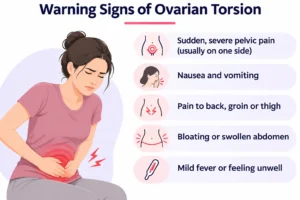
Here are the ovarian torsion symptoms to look out for: 

  • Sharp, stabbing or cramping pain in the lower belly or pelvis, usually on one side
  • Nausea and vomiting that comes with the pain
  • Pain that spreads to the back, groin or thigh
  • A tender, bloated or swollen lower abdomen
  • Mild fever or a general unwell feeling

Infographic of ovarian torsion symptoms: sudden severe pelvic pain on one side, nausea and vomiting, pain spreading to the back or groin, bloating, and mild fever

There is a catch. In some women the ovary twists and then untwists by itself, so the pain comes in waves and then disappears. This is called intermittent torsion. If the pain fades, don’t assume the problem has gone, because it can return, sometimes more severely.

To sum up, sudden one-sided pelvic pain with nausea or vomiting is the most important warning sign of ovarian torsion and should never be ignored.

How is Ovarian Torsion Pain Different From Period Cramps?

Period pain builds gradually, is felt on both sides and eases with rest or a pain reliever. Ovarian torsion pain often comes on suddenly, sits mostly on one side and tends to persist or return in waves. 

  • Onset: Period cramps build slowly. Torsion pain often strikes suddenly.
  • Location: Period pain is usually felt across the lower belly. Torsion pain is mostly on one side.
  • Timing: Cramps follow your cycle and ease within a day or two. Torsion pain can strike mid-cycle, after exercise or even at rest.
  • Relief: Period pain settles with rest or a pain reliever. Torsion pain usually doesn’t settle fully, or returns in waves.
  • Other symptoms: Vomiting is a clue, since ordinary cramps rarely cause it.

Other conditions can look similar, including appendicitis, a burst ovarian cyst, a kidney stone and ectopic pregnancy. That is why you shouldn’t diagnose yourself. A doctor needs to examine you and run tests.

Pain that is sudden, one-sided, severe and paired with vomiting should be checked by a doctor right away, not dismissed as normal period pain.

Who is at Higher Risk of Ovarian Torsion?

Women with an ovarian cyst or ovarian mass are at higher risk, because the extra weight makes the ovary more likely to twist. Torsion can happen at any age, but it is most common during the reproductive years.

These are the most common risk factors: 

  • Ovarian cysts or growths, especially larger ones
  • Pregnancy, particularly the first trimester, when the ovaries are enlarged
  • Fertility treatment, since ovarian stimulation can enlarge the ovaries
  • A previous episode of ovarian torsion
  • Conditions that cause multiple cysts, such as PCOS

Having a risk factor doesn’t mean torsion will happen. Most women with ovarian cysts never experience it. But it is a good reason to follow up on any cyst your doctor finds, and to know the warning signs in advance.

When Should You Go to the Emergency Room for Pelvic Pain?

Go to the emergency room if you have sudden, severe pelvic pain, especially with vomiting, fever, dizziness or fainting. Don’t wait to see if it passes.

It is natural to hesitate. Nobody wants to rush to the hospital for what might turn out to be nothing. But with suspected torsion, the cost of waiting is much higher than the cost of a false alarm. Most doctors would rather check a false alarm than miss a true emergency .

Head to emergency care right away if: 

  • The pain is so strong that you can’t stand upright or find a comfortable position
  • You are vomiting repeatedly along with the pain
  • You are pregnant, or think you might be, and have sudden one-sided pain
  • You have a known ovarian cyst and new, sharp pain appears

So if sudden, severe pelvic pain strikes, treat it as an emergency and get to a hospital without delay.

How is Ovarian Torsion Diagnosed?

Doctors diagnose ovarian torsion using your symptoms, a physical exam and a pelvic ultrasound with Doppler, which checks blood flow to the ovary. Sometimes the final answer comes only during surgery.

  • History and exam: The doctor asks about the pain and examines your abdomen.
  • Ultrasound with Doppler: Shows the ovary’s size, any cyst, and blood flow.
  • Pregnancy test and blood work: Help rule out other causes.
  • Minimally invasive surgery (keyhole or robotic assisted): Used when symptoms strongly suggest torsion but the scan isn’t clear.

A normal ultrasound or Doppler result doesn’t rule out torsion. If a twisted ovary is strongly suspected, the doctor may recommend minimally invasive surgery, including robotic-assisted surgery where available, to confirm and treat it.

Symptoms, examination and ultrasound guide diagnosis, and minimally invasive surgery may be used when the picture is unclear.

How is Ovarian Torsion Treated?

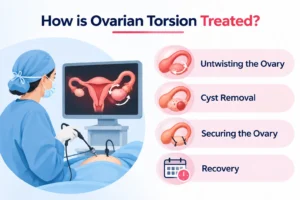
Ovarian torsion treatment is surgery to untwist the ovary and restore its blood flow. It is usually done through minimally invasive robotic surgery, which uses small cuts instead of one large incision.

  • Untwisting the ovary: The surgeon gently turns the ovary back to its normal position so blood can flow again.
  • Cyst removal: If an ovarian cyst caused the twist, it may be removed at the same time or at a later stage, depending on your situation 
  • Securing the ovary: In selected cases, such as repeated torsion, the surgeon may fix the ovary in place to lower the chance of it twisting again. 
  • Recovery: Healing after minimally invasive surgery is typically quicker than after open surgery. Your doctor will advise you on how much rest you need.

Infographic showing how ovarian torsion is treated with minimally invasive surgery: untwisting the ovary, cyst removal, securing the ovary and recovery

Surgery to untwist the ovary is the standard treatment for ovarian torsion, and it is usually done through small cuts.

Can the Ovary Be Saved After Torsion?

Yes, in most cases the ovary can be saved if torsion is treated promptly. Even an ovary that looks dark or bruised can often recover once blood flow returns, which is why surgeons try to preserve it wherever possible.

Removal is rarely needed. Even a dark or bruised-looking ovary is usually preserved, and removal is considered only if the ovary is too damaged to be saved. Even then, a woman with one healthy ovary can usually still ovulate and conceive

Prompt care gives the best chance of saving the ovary and protecting future fertility.

When Should You See a Gynaecologist for Ovarian Torsion in Gurgaon?

Seek emergency care immediately if you have sudden, severe pain on one side of your lower abdomen, especially with nausea or vomiting.

Many women dismiss this kind of pain as a bad period or gas and wait it out. With ovarian torsion, that wait can cost the ovary. This matters even more if you have an ovarian cyst, are pregnant, or are on fertility treatment. Once the emergency is addressed, you can consult Dr. Aruna Kalra, Obstetrician and Gynaecologist at CK Birla Hospital, Gurgaon, or a gynaecologist of your choice, for follow-up care.

Final Thoughts

Ovarian torsion is uncommon, but it is serious, and the difference between a good and a difficult outcome often comes down to time. If you remember one thing from this blog, make it this: sudden, severe, one-sided pelvic pain, especially with nausea or vomiting, is not something to wait out at home.

Know your risk factors, take ovarian cysts seriously and follow up on them, and trust your instincts when something feels very wrong. If you have questions about ovarian cysts or recurring pelvic pain, you can consult Dr. Aruna Kalra at CK Birla Hospital, Gurgaon, or any gynaecologist of your preference.

Medical Disclaimer: This blog is for general awareness and does not replace personalised medical advice, diagnosis or treatment. Please consult a qualified gynaecologist for your specific condition.

Frequently Asked Questions

1. What does ovarian torsion pain feel like?

It usually feels like a sudden, sharp or stabbing pain on one side of the lower abdomen, often with nausea and vomiting. Some women describe it as cramping that comes in waves.

2. Can ovarian torsion go away on its own?

The ovary can sometimes untwist by itself, which causes the pain to ease. But the torsion can return, and it can also cause lasting damage. Anyone with these symptoms should see a doctor even if the pain settles.

3. How long can you have ovarian torsion before the ovary is damaged?

There is no fixed time. It varies from person to person, but the longer the ovary stays twisted, the greater the risk of permanent damage. That is why early emergency care matters.

4. Does ovarian torsion affect fertility?

Prompt treatment usually preserves the ovary, so fertility is often unaffected. Even if one ovary is lost, the remaining ovary can usually support ovulation and pregnancy.

5. Can ovarian torsion happen during pregnancy?

Yes. It is more common in early pregnancy, when the ovaries are enlarged. Any sudden, severe one-sided abdominal pain during pregnancy needs urgent medical attention.

Dr. Aruna Kalra's Medical Content Team

Dr. Aruna Kalra's Medical Content Team

Dr. Aruna Kalra's medical content team specialises in creating accurate, clear, and patient-focused healthcare content. With strong clinical understanding and expertise in technical writing and SEO, the team translates complex medical information into reliable, accessible resources that support informed decisions and uphold Dr. Aruna Kalra’s commitment to quality care.

This content is reviewed by

Dr. Aruna Kalra

Gynaecologist and Obstetrician

Dr Aruna Kalra is a senior gynaecologist and obstetrician with over 25 years of clinical experience, widely respected for her calm clinical judgement, ethical decision-making, and expertise in advanced gynaecological surgery and obstetric care.

Leave a Reply

Your email address will not be published. Required fields are marked *