Your consultation request has been successfully registered. Our counsellor will connect with you within the next working hour.
Need immediate help?
Call Us
Imagine being told you have “stage 2 endometriosis” and walking out of the clinic with more questions than answers. Is that serious? Will it get worse? Does it mean you can’t have a baby? Many women feel exactly this way, mostly because the word “stage” sounds like it should measure how bad things feel. It doesn’t. Let’s untangle what endometriosis stages really mean, in plain language.
If you’ve ever been told your period pain is “just normal,” you’re not alone. Endometriosis is widely misunderstood, and its staging most of all. Think of endometriosis stages as a weather map: it shows where the clouds have gathered in your pelvis, but not how stormy your days feel. Let’s read that map together, from stage 1 to stage 4 endometriosis.
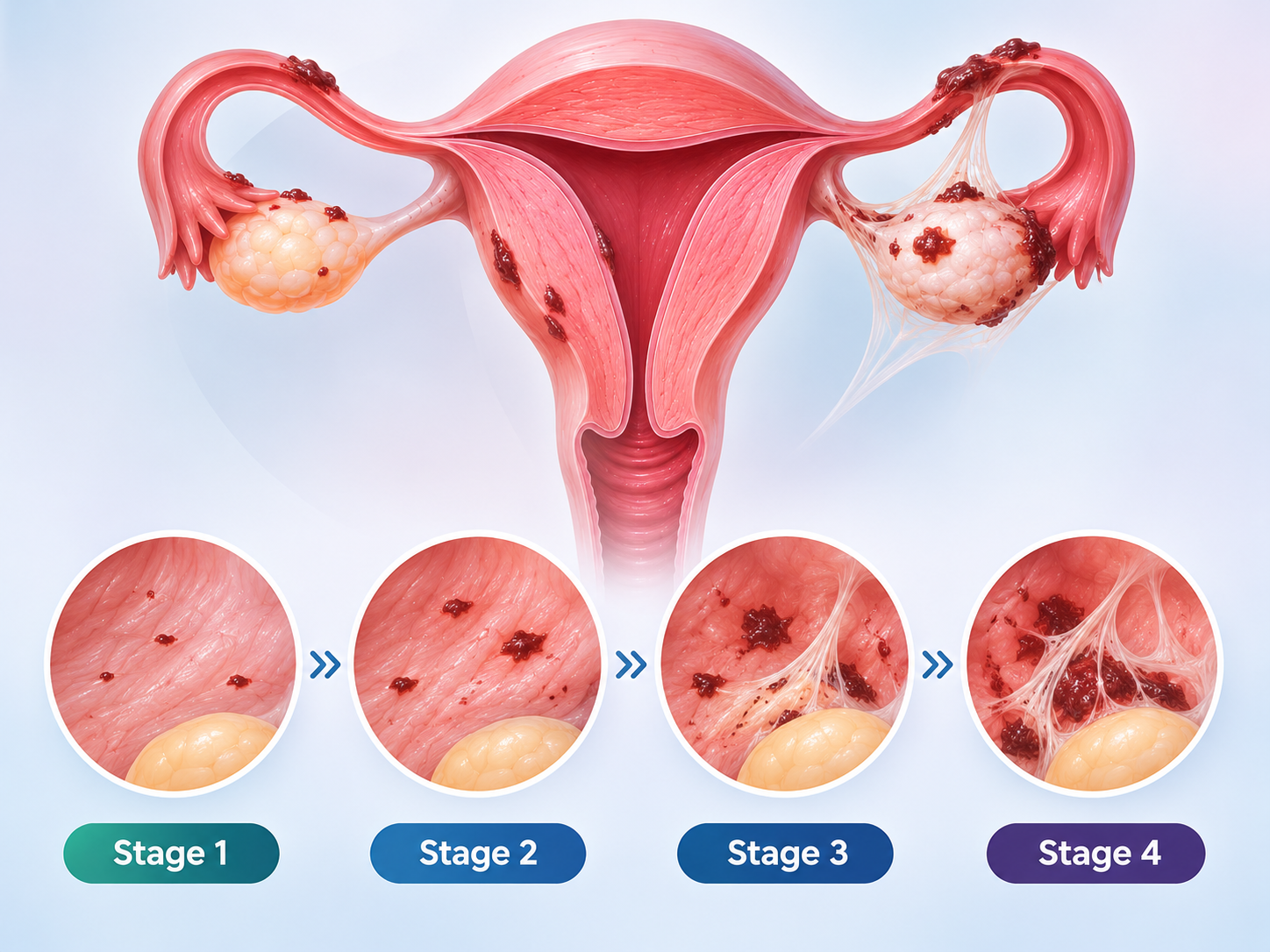
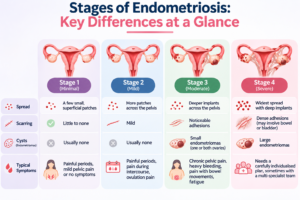
The stages of endometriosis are four categories, from stage 1 (minimal) to stage 4 (severe), that describe how much endometriosis tissue is present and how deeply it has spread inside the pelvis.
Endometriosis happens when tissue similar to the womb lining grows outside the uterus, on the ovaries, fallopian tubes or the lining of the pelvis. To stage it, doctors commonly use the rASRM classification, which awards points for the size, depth and spread of this tissue, and for scar tissue called adhesions. Your total score places you in one of four stages. Here’s what each one looks like on the weather map:
Staging helps your gynaecologist plan your care, but it is only one piece of your story.
Stage 1 endometriosis (minimal) means a few small, shallow patches of tissue are present on the pelvic lining, with little or no scarring.
Picture a few scattered leaves on a lawn. That is stage 1: tiny, shallow spots, not yet deep or widespread. Some women still have strong period pain, while others notice nothing and only find out while investigating trouble conceiving. Because the patches are so small, they are easily missed on an ultrasound, which is one reason minimal endometriosis often goes undiagnosed for years.
Here’s what stage 1 typically looks like:
Stage 1 is the earliest and smallest form of endometriosis, but it can still be felt, and it is always worth getting checked.
Stage 2 endometriosis (mild) involves more patches than stage 1, some sitting slightly deeper, with only mild scarring.
Here, the tissue has spread a little further across the pelvic lining or ovaries. Many women notice painful periods, discomfort during intercourse, or a dull ache around ovulation. Even so, the pelvic organs are usually still free and mobile, and care is often shaped around how you feel rather than the number on your report.
Here’s what stage 2 typically looks like:
Stage 2 shows a slightly wider spread with limited scarring, and the plan is usually built around your symptoms.
Stage 3 endometriosis (moderate) means deeper implants, small endometriomas on one or both ovaries, and noticeable adhesions.
This is where things begin to change structurally. Endometriomas, often called “chocolate cysts” because the old blood inside looks dark and thick, may form on the ovaries, while adhesions (bands of scar tissue) can start tethering organs together. That said, some women with stage 3 report surprisingly mild symptoms.
Here’s what stage 3 typically looks like:
Stage 3 reflects deeper tissue and early structural changes in the pelvis.
Stage 4 endometriosis (severe) is the most extensive form, with deep implants, large endometriomas, and dense adhesions that may bind the uterus, ovaries, tubes or bowel together.
In some women, the scarring is so widespread that pelvic organs stick to one another, sometimes called a “frozen pelvis,” and the bowel or bladder may also be involved. This is why severe endometriosis often needs a detailed plan involving imaging, a gynaecologist, and sometimes a surgeon or urologist. Yet even here, symptoms vary widely from person to person.
Here’s what stage 4 typically looks like:
Stage 4 means the greatest spread, and it calls for a carefully individualised plan.

No. The stage of endometriosis does not reliably predict how much pain you feel.
This surprises almost everyone. A woman with stage 1 can have debilitating cramps, while someone with stage 4 may have few symptoms. The reason is that pain depends on where the tissue sits, how close it is to nerves, and how your body reacts to inflammation, rather than on how much tissue there is. Also, endometriosis does not always move from stage 1 to stage 4. In many women it stays the same for years, and in some it may change. So please don’t compare your stage with a friend’s; your endometriosis symptoms deserve attention at any stage.
Endometriosis is diagnosed through a detailed history, a pelvic examination and imaging such as ultrasound or MRI, while the robotic system, advised in selected cases, also allows formal staging.
Your doctor will start by listening to your symptoms. A transvaginal ultrasound or MRI can show cysts and deeper disease, but small surface patches often need robotic system for accurate staging. When treatment is needed, minimally invasive surgery, including robotic-assisted techniques, may be considered in selected cases. Not everyone needs surgery, and your gynaecologist will advise what suits you.
Diagnosis combines your story, your scans and, sometimes, a direct look inside.
Endometriosis can affect fertility at any stage, but many women with endometriosis conceive, either naturally or with support.
Scarring, blocked tubes, or ovarian cysts may make conception harder, particularly in later stages. Even so, a diagnosis of endometriosis and infertility concerns does not mean pregnancy is out of reach. Depending on age, ovarian reserve, and stage, options may range from monitored natural attempts to ovulation-stimulating medication, IUI, surgery or assisted reproduction. The right path is different for everyone, so an early conversation with your gynaecologist helps you plan with clarity rather than worry.
In brief, staging informs fertility planning, but it does not decide your outcome.
See a gynaecologist if period pain disrupts your routine, pain persists between periods, intercourse is painful, or you have difficulty conceiving.
Many women are told for years that “painful periods are normal.” They aren’t always. If your symptoms keep returning or are affecting work, relationships, or sleep, it is worth getting evaluated. You can consult Dr. Aruna Kalra, Obstetrician and Gynaecologist at CK Birla Hospital, Gurgaon, or a gynaecologist of your choice, for a proper assessment and a plan that suits you.
Painful periods that keep interfering with your life deserve answers, not silence.
If there is one thing to take away, it is this: the stage of endometriosis tells your doctor where the tissue is, not how you feel or what your future holds. Stage 1 can hurt, stage 4 can be quiet, and many women conceive at every stage, with or without medical support. What matters most is recognising your symptoms early, getting a proper evaluation, and building a plan around you, not just your report. You know your body best, so if something feels off, trust that instinct and reach out for guidance.
No. Many women are diagnosed through symptoms, examination and imaging such as transvaginal ultrasound, and some are managed with medicines alone. Minimally invasive robotic surgery is considered only in selected cases, and your gynaecologist will advise what suits you.
2. Does endometriosis get worse over time?
Not always. Endometriosis may stay stable for years in some women and change in others, so it does not automatically move from stage 1 to stage 4. Regular follow-up with your gynaecologist helps track any changes in your endometriosis symptoms.
3. Is stage 4 endometriosis treatable?
Stage 4 endometriosis can be managed. Depending on your symptoms and goals, care may include medicines, minimally invasive surgery (including robotic-assisted techniques in selected cases), or a combination. Your gynaecologist will suggest a plan suited to you.
4. Can I get pregnant with stage 3 endometriosis?
Many women with stage 3 endometriosis do conceive, either naturally or with medical support. Chances depend on factors such as age, ovarian reserve and the presence of endometriomas or adhesions, so a personalised consultation helps.
5. Are endometriosis stages the same as pain levels?
No. Endometriosis stages describe how much tissue and scarring is present, not how much pain you feel. A woman with stage 1 endometriosis can have severe pelvic pain, while someone with stage 4 may have mild symptoms.
Dr. Aruna Kalra's medical content team specialises in creating accurate, clear, and patient-focused healthcare content. With strong clinical understanding and expertise in technical writing and SEO, the team translates complex medical information into reliable, accessible resources that support informed decisions and uphold Dr. Aruna Kalra’s commitment to quality care.
Dr Aruna Kalra is a senior gynaecologist and obstetrician with over 25 years of clinical experience, widely respected for her calm clinical judgement, ethical decision-making, and expertise in advanced gynaecological surgery and obstetric care.