Call Back Call Back WhatsApp Whatsapp
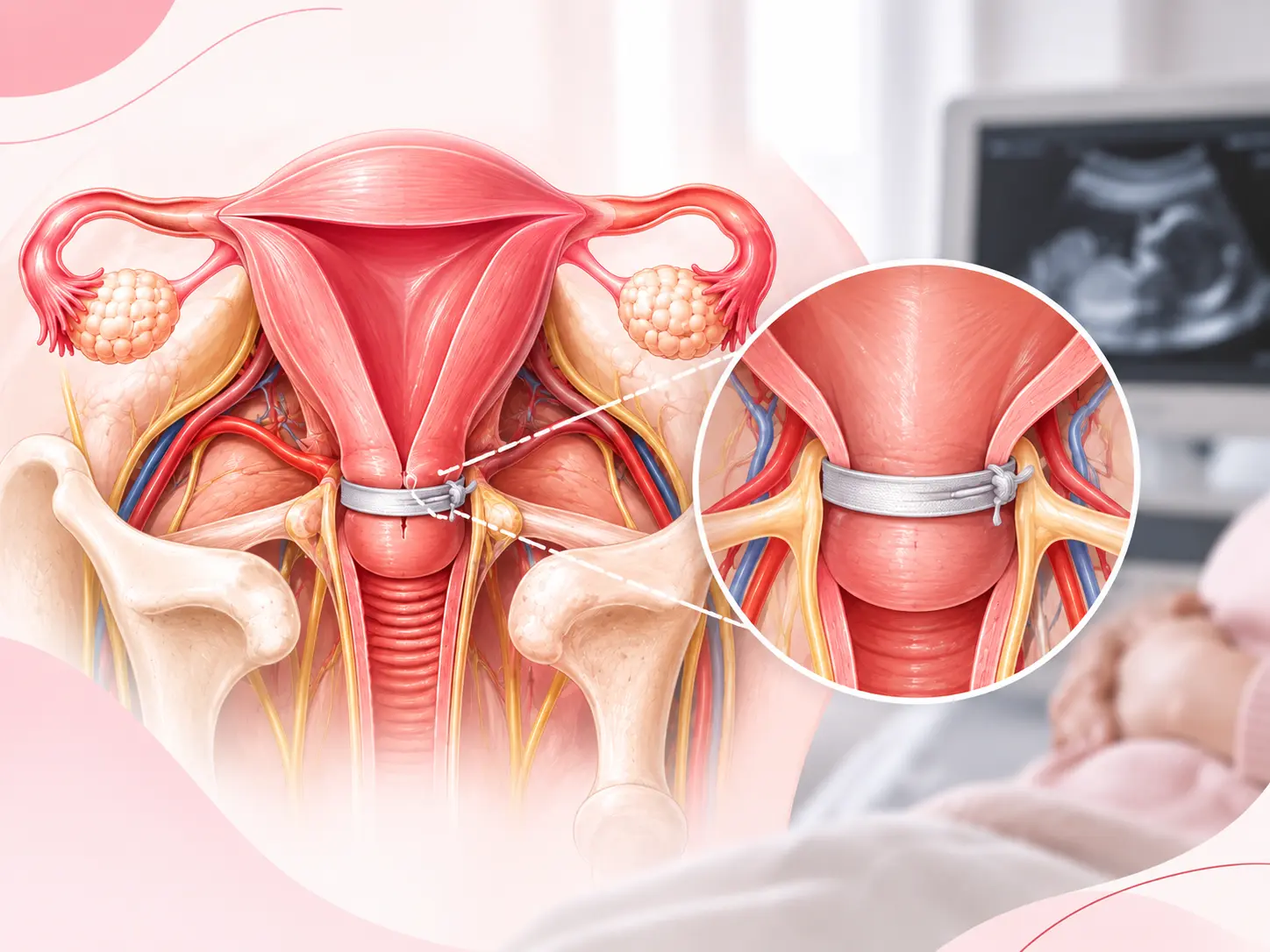
Detailed Uterine Cerclage Medical Illustration

Abdominal Cerclage for Repeated Second-Trimester Miscarriage

A scan at 12 weeks looks reassuring. Then, somewhere between 16 and 24 weeks, with no pain and no bleeding, the pregnancy is lost. When this happens more than once, couples naturally look for answers. For some women, the cause is a cervix that cannot stay closed as the pregnancy advances, and abdominal cerclage may be one of the options discussed. This blog explains the condition and the procedure in simple language so you can have a well-informed conversation with your doctor.

Abdominal cerclage (also called transabdominal cerclage) is a surgical stitch placed around the upper cervix, through the abdomen, to keep it closed during pregnancy. It is considered for women with repeated second trimester miscarriage due to cervical insufficiency, usually when a vaginal stitch has failed or cannot be placed.

What is an abdominal cerclage and how does it work?

An abdominal cerclage is a strong band placed around the top of the cervix, through the abdomen instead of the vagina, to support it during pregnancy.

Think of the cervix as the neck of a balloon. As the baby grows, pressure builds inside, and a weak neck slowly gives way. A cerclage works like a firm knot at that point. The abdominal route places the band higher than a vaginal stitch can reach, where the cervix meets the uterus, and it is designed to stay in place permanently.

In short, it is a high and lasting support for a cervix that needs more help than a standard stitch can give.

What is cervical insufficiency and how is it identified?

Cervical insufficiency (also called cervical incompetence) means the cervix opens painlessly in the second trimester, without contractions, bleeding or infection, leading to a late miscarriage or very early birth. It is estimated to affect around 1 in 100 pregnancies.

Possible contributors include previous cervical surgery such as a cone biopsy, a cervical tear during an earlier delivery, a naturally short cervix, or certain connective tissue conditions. Sometimes no cause is found. Diagnosis rests mainly on your obstetric history, supported by an ultrasound measurement of cervical length (under 25 mm before 24 weeks is a concern). Your doctor may also test for other causes of second-trimester loss, such as infection, uterine shape differences or clotting disorders.

So, if your losses were painless and happened at a similar stage each time, cervical insufficiency deserves a careful look.

When is abdominal cerclage recommended instead of a vaginal stitch?

A vaginal cerclage is usually tried first. In the abdominal cerclage vs vaginal cerclage decision, the abdominal route is considered when a vaginal stitch has failed in an earlier pregnancy, or when the cervix is too short or scarred to hold one.

Doctors may consider abdominal cerclage in certain situations, such as:

  • a second-trimester loss or very early birth despite a vaginal stitch
  • a very short or absent cervix after a cone biopsy or trachelectomy
  • significant cervical scarring or tears
  • a congenitally short cervix

After a single loss, other measures such as vaginal progesterone, a cervical pessary or serial cervical-length scans may be considered first. 

When is the abdominal cerclage performed?

A vaginal cerclage is usually tried first. Abdominal cerclage is considered when a vaginal stitch has failed in an earlier pregnancy, or when the cervix is too short or scarred to hold one.

Your doctor may suggest an abdominal cerclage if you have any of the following:

  • A second-trimester loss or very early birth despite a vaginal stitch
  • A very short or absent cervix after a cone biopsy or trachelectomy
  • Significant cervical scarring or tears
  • A congenitally short cervix (a cervix that is naturally short since birth)

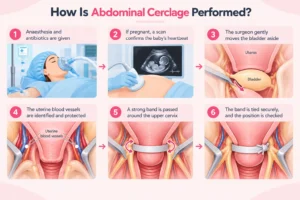
How is abdominal cerclage performed? (image)

Abdominal cerclage is done under anaesthesia, by open surgery or by minimally invasive methods, including laparoscopic and robotic-assisted surgery, to place a strong band around the cervix. 

How Abdominal Cerclage Is Performed?

In short, the procedure places a firm, lasting support at the top of the cervix. The approach and timing are chosen to suit each woman’s medical history and stage of pregnancy.

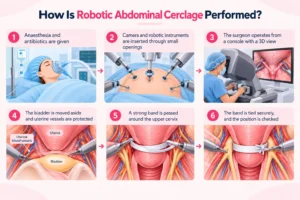
How Is Robotic Abdominal Cerclage Performed?

Robotic abdominal cerclage places the same supportive band around the cervix as open surgery, using small openings and instruments controlled by the surgeon from a console.

Robotic Abdominal Cerclage in six steps

In short, robotic surgery is another way of placing the same supportive band, and your doctor will advise whether it is suitable for you. 

How effective is abdominal cerclage?

Abdominal cerclage has shown encouraging results in women who lost pregnancies despite an earlier vaginal stitch.

  • Most women in this situation go on to deliver a live baby, with success rates often reported at around 85 to 90 percent
  • Results are not guaranteed and vary from one woman to another
  • Outcomes depend on the cause and severity of cervical insufficiency
  • The timing of the surgery also plays a role
  • A twin pregnancy can affect the outcome
  • Infection or other pregnancy complications can also influence the result

To sum up, the outlook is encouraging, but every pregnancy is different.

What are the risks of abdominal cerclage, and what happens after surgery?

Like any surgery, abdominal cerclage carries some risks, and knowing what to expect afterwards helps you prepare.

Possible risks of abdominal cerclage surgery:

  • Bleeding
  • Infection
  • Injury to the bladder, bowel or blood vessels
  • Reaction to anaesthesia
  • When done in pregnancy: miscarriage, preterm labour or early rupture of membranes
  • If labour begins very early, the stitch may need surgical removal

What happens after surgery:

  • Most women stay in hospital for a few days
  • Regular follow-up visits and scans are scheduled
  • You will be advised to avoid heavy lifting while you heal
  • The baby is usually delivered by planned caesarean section between 37 and 39 weeks
  • The band can stay in place for future pregnancies, and removal can be discussed if your family is complete.

Seek immediate medical care if you notice fever, heavy bleeding, severe pain, leaking fluid, regular tightening or reduced baby movements.

When should you consult a gynaecologist about repeated miscarriage?

Consider a consultation after two or more second-trimester losses, or after one painless loss if you have had previous cervical surgery. Ideally, plan this before your next pregnancy so tests can be completed and a clear plan made.

Useful questions to ask your doctor:

  • Do my losses fit cervical insufficiency, and which tests do I need?
  • Am I suitable for abdominal cerclage, or are there alternatives?
  • Is it better before or during pregnancy, and open or laparoscopic?
  • What are the specific risks in my case?

Please remember that in most cases, cervical insufficiency is not caused by anything you did. Counselling and emotional support after repeated loss are important parts of care.

When to See a Gynaecologist in Gurgaon?

Consider a consultation after two or more second-trimester losses, or after one painless loss if you have had cervical surgery, ideally before your next pregnancy. If you are pregnant, seek urgent care for fever, heavy bleeding, severe pain, leaking fluid, regular tightening or reduced baby movements.

For guidance specific to your history, you may consult Dr. Aruna Kalra, Obstetrician and Gynaecologist at CK Birla Hospital, Gurgaon, or a qualified gynaecologist of your choice.

Final Thoughts

Repeated second-trimester miscarriage is exhausting, but understanding the cause is the first step forward. For women with cervical insufficiency, abdominal cerclage can offer strong, lasting support to the cervix when other measures have not been enough.

Every woman’s history is different, so the right treatment and timing should be decided with a qualified gynaecologist after proper evaluation. Asking questions early and planning ahead can help you feel more prepared for your next pregnancy.

Frequently Asked Questions

  1. How long should I wait to conceive after an abdominal cerclage?
    If the cerclage is placed before pregnancy, surgeons usually allow a period of weeks to a few months for healing. The exact timing depends on your recovery, so follow your surgeon’s advice.
  2. Can I have sex after an abdominal cerclage?
    Because the band sits above the cervix, intercourse does not dislodge it. Most surgeons allow it after recovery, but some advise avoiding it during pregnancy in certain situations. Confirm with your own doctor.
  3. Will an abdominal cerclage leave a visible scar?
    Open surgery usually leaves a low horizontal scar, similar to a caesarean scar. Laparoscopic surgery leaves a few small keyhole marks that fade with time.
  4. How much does an abdominal cerclage cost, and does insurance cover it?
    Cost varies with the hospital, city, surgical approach, room category and length of stay. Ask the hospital for a written estimate, and check your policy for cover and pre-authorisation.
  5. Can I travel by air during pregnancy after an abdominal cerclage?
    A pregnancy with a cerclage is considered higher risk, so many doctors advise limiting non-essential travel. Get your doctor’s clearance first and carry your medical records.
Dr. Aruna Kalra's Medical Content Team

Dr. Aruna Kalra's Medical Content Team

Dr. Aruna Kalra's medical content team specialises in creating accurate, clear, and patient-focused healthcare content. With strong clinical understanding and expertise in technical writing and SEO, the team translates complex medical information into reliable, accessible resources that support informed decisions and uphold Dr. Aruna Kalra’s commitment to quality care.

This content is reviewed by

Dr. Aruna Kalra

Gynaecologist and Obstetrician

Dr Aruna Kalra is a senior gynaecologist and obstetrician with over 25 years of clinical experience, widely respected for her calm clinical judgement, ethical decision-making, and expertise in advanced gynaecological surgery and obstetric care.

Leave a Reply

Your email address will not be published. Required fields are marked *