Your consultation request has been successfully registered. Our counsellor will connect with you within the next working hour.
Need immediate help?
Call Us
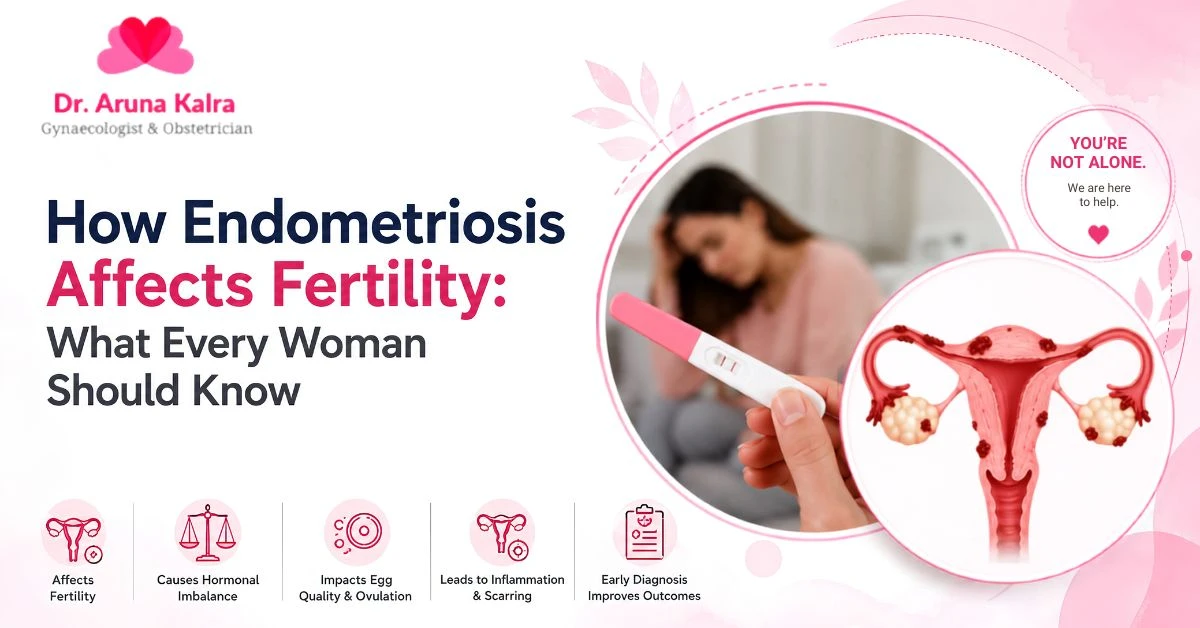
Endometriosis is one of the leading yet often overlooked causes of infertility in women. Many women suffer from painful periods, chronic pelvic pain, or difficulty conceiving without realizing that endometriosis may be the underlying cause.
The encouraging news is that early diagnosis and timely treatment can significantly improve fertility outcomes. With advances in minimally invasive and robotic surgery, many women with endometriosis are able to conceive naturally or with fertility assistance.
In this article, we’ll explain how endometriosis affects fertility, its symptoms, diagnosis, treatment options, and when you should consult an experienced endometriosis specialist.
Endometriosis is a condition in which tissue similar to the lining of the uterus (endometrium) grows outside the uterus.
This tissue may grow on:
Like the uterine lining, this tissue responds to hormonal changes every month. However, because it cannot leave the body during menstruation, it causes inflammation, bleeding, scar tissue, and adhesions.
Endometriosis affects approximately 1 in 10 women of reproductive age worldwide.
Many women remain undiagnosed for years because symptoms are often mistaken for “normal period pain.”
Early diagnosis plays a crucial role in preserving fertility and preventing disease progression.
Not every woman with endometriosis experiences infertility, but the condition can reduce the chances of conception in several ways.
Endometriosis may cause ovarian cysts known as endometriomas (chocolate cysts).
These cysts can:
Inflammation and scar tissue can block or distort the fallopian tubes, preventing the egg and sperm from meeting.
Endometriosis often leads to adhesions—bands of scar tissue that may cause reproductive organs to stick together.
This can interfere with:
Persistent inflammation within the pelvis may negatively affect:
Endometriosis may alter the hormonal environment necessary for successful ovulation and implantation.
Symptoms vary from mild to severe and may include:
Interestingly, the severity of symptoms does not always reflect the severity of the disease.
Consult a specialist if you experience:
Early intervention often leads to better fertility outcomes.
Your doctor may recommend:
Laparoscopy remains the gold standard for diagnosing and staging endometriosis.
Treatment depends on:
Options include:
These treatments help control symptoms but are generally not used when actively trying to conceive.
Minimally invasive laparoscopic surgery allows the surgeon to remove endometriosis tissue while preserving healthy reproductive organs.
Benefits include:
For advanced or deeply infiltrating endometriosis, robotic-assisted surgery offers:
Depending on individual circumstances, your doctor may recommend fertility treatments such as ovulation induction, intrauterine insemination (IUI), or IVF.
Yes.
Many women with endometriosis go on to have healthy pregnancies.
Success depends on factors including:
Early diagnosis significantly improves the chances of successful conception.
Women with endometriosis may improve their reproductive health by:
Dr. Aruna Kalra is one of the most trusted Gynaecologists and Obstetricians in Gurgaon, Haryana, with over 25 years of experience in women’s healthcare and advanced gynaecological surgery.
She currently serves as:
Dr. Aruna specializes in:
Her compassionate approach, combined with advanced surgical expertise, enables women with endometriosis to receive personalized treatment aimed at relieving pain, preserving fertility, and improving quality of life.
Dr. Aruna began her medical career at Kasturba Hospital, Delhi, and later gained valuable experience at Batra Hospital, New Delhi, and Paras Hospital, Gurugram. She has advanced training in robotic surgery and laparoscopic surgery and is widely recognized for successfully treating complex gynaecological conditions using the latest minimally invasive techniques.
1. Can mild endometriosis cause infertility?
Yes. Even mild endometriosis can affect fertility by causing inflammation or interfering with implantation.
2. Is surgery always necessary?
No. Treatment depends on symptoms, age, disease severity, and pregnancy plans.
3. Can endometriosis come back after surgery?
Yes, recurrence is possible. Regular follow-up and appropriate medical management help reduce the risk.
4. Does robotic surgery improve fertility?
For selected patients with moderate to severe endometriosis, robotic surgery offers excellent precision and may help preserve healthy reproductive tissue, potentially improving fertility outcomes.
Endometriosis is a common but manageable condition that can affect fertility if left untreated. Recognizing the symptoms early and consulting an experienced gynaecologist can make a significant difference in preserving reproductive health.
With modern laparoscopic and robotic surgical techniques, along with personalized fertility-focused care, many women with endometriosis can successfully achieve pregnancy and enjoy a better quality of life.